Most Efficient Compliance Automation Platforms for Cybersecurity Firms
Most Efficient Compliance Automation Platforms for Cybersecurity Firms
March 9, 2026, 11 min read
Table of Contents
Compliance has become a growth function as much as a security requirement. For cybersecurity firms, staying audit-ready, responding to customer security reviews quickly, and managing evidence across multiple frameworks can directly affect revenue, trust, and operational efficiency. The challenge is that many teams are still stuck with fragmented workflows, manual screenshots, spreadsheet-based tracking, and time-consuming back-and-forth between security, engineering, and auditors.
That is why compliance automation platforms are gaining so much traction. The right platform does more than help you pass an audit. It can reduce manual effort, speed up remediation, improve visibility across frameworks, and turn compliance into an ongoing, scalable process instead of a last-minute scramble. In this guide, we compare some of the most efficient compliance automation platforms for cybersecurity firms and break down where each one fits best.
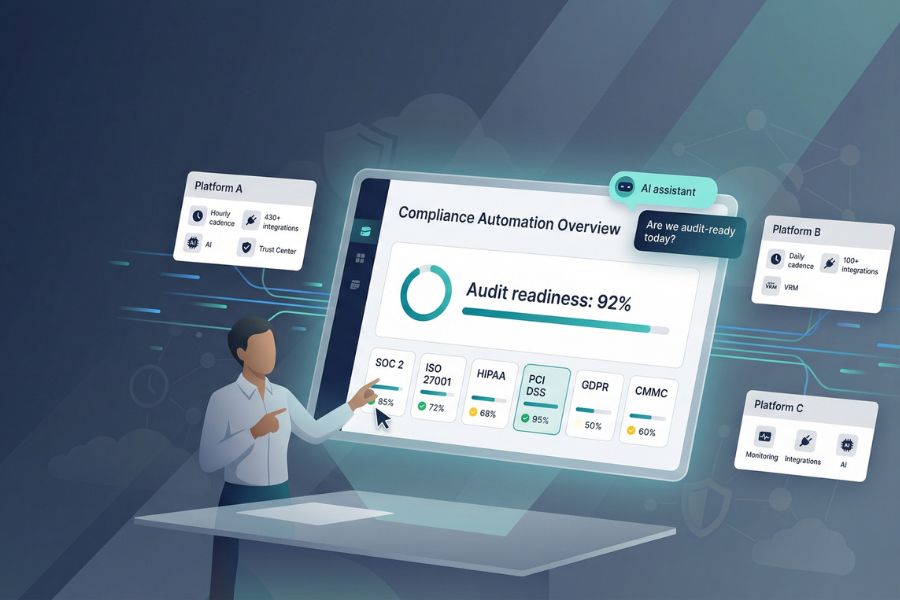
Compliance automation has moved from a nice-to-have to a core operating requirement for cybersecurity firms that need to stay audit-ready without turning evidence collection into a full-time job. The best platforms do more than track controls. They reduce manual work, surface gaps faster, support multiple frameworks, and help security teams move from reactive audits to continuous assurance.
Below is a practical breakdown of four leading platforms for cybersecurity firms: Vanta, Hyperproof, Scrut Automation, and LogicGate Risk Cloud. Each platform serves a different maturity level, operating model, and compliance goal.
Vanta: Best for Rapid SOC 2 Readiness and Deep Integrations
Vanta is a trust management platform built for security and compliance leads who want continuous compliance without building a homegrown evidence machine. It is the category creator in compliance automation software, with more than 1,200 automated tests running hourly across 400+ integrations. That breadth shows in what it covers out of the box, from audit readiness to customer trust workflows.
Where Vanta stands out is automation depth. It offers roughly 430 integrations and 1,200+ automated tests that run hourly, so control drift shows up quickly instead of waiting for a quarterly scramble. For AWS specifically, Vanta runs around 130+ automated tests, which is one reason teams use it as a “set the baseline once, then monitor continuously” system instead of just an audit checklist.
Vanta also supports 35+ frameworks and cross-maps controls so teams can reuse evidence across SOC 2, ISO 27001, HIPAA, PCI DSS, GDPR, CMMC, and more. If your roadmap is “SOC 2 now, ISO next, and CMMC later,” the value is that you are not rebuilding the same control set three times.
AI is not bolted on as a sidebar. Vanta uses it across the workflow, including remediation guidance with code snippets, policy drafting support through Smart Policy Builder and a policy chatbot, evidence evaluation to surface gaps, and Questionnaire Automation that can reach up to a 95% answer acceptance rate. That matters for mid-market teams because security reviews can be as much of a bottleneck as the audit itself.
Vanta is ideal for:
50 to 2,000 employee teams that want to get audit-ready in weeks, then stay there with hourly monitoring
Companies that need multi-framework coverage without duplicating controls and evidence
Security and compliance leaders who want compliance plus trust workflows, such as a Trust Center and faster questionnaire handling
Trust and deal acceleration: Vanta’s Trust Center can share live compliance posture with prospects. It also has a large network footprint, with 5,000+ public Trust Centers, which supports a more self-serve buyer experience when sales teams are fielding repeated security requests.
Vendor risk management: Vanta includes a full VRM module, including AI-powered vendor reviews, a centralized vendor portal, automated discovery and evidence collection, and continuous monitoring. For teams trying to operationalize third-party risk, not just track it in a spreadsheet, this is a meaningful step up from annual vendor review season.
Pricing and trade-offs: Vanta is positioned as a premium platform, with packages such as Core, Core Plus, Plus, Growth, and Scale. Pricing starts around $1,000/month depending on configuration. The trade-off is that Vanta’s workflows are opinionated. If you need highly bespoke process modeling across multiple GRC functions, a more build-your-own platform may fit better. For most mid-market teams optimizing for speed, automation depth, and trust acceleration, Vanta is the benchmark.
Hyperproof: Best for Scaling Multi-Framework Programs, Not Plug-and-Play Automation
Hyperproof is a GRC platform designed to help teams manage complex compliance programs across many frameworks. It is less of a “connect your stack and everything verifies itself” tool, and more of a central workspace for mapping controls, tracking ownership, and organizing evidence when your compliance footprint gets large.
That distinction matters for mid-market teams. If your primary pain is evidence collection and control testing across AWS, Okta, GitHub, and endpoint tooling, Hyperproof generally requires more manual effort than automation-first platforms. If your pain is keeping multiple frameworks aligned as requirements sprawl, Hyperproof is built for that job.
Hyperproof’s core strength is multi-framework organization. Controls can be mapped across SOC 2, ISO, NIST, FedRAMP, HIPAA, and other standards, and the platform is designed to stay usable even when programs grow into thousands of controls. Hyperproof also positions itself as having a very large framework library.
On integrations, the reality is narrower than many compliance automation platforms. Expert research puts Hyperproof at around 70 integrations. “Hypersyncs” can pull evidence on a schedule, but the automation depth is described as shallow compared to vendors that ship large volumes of automated tests. There is also no AI-driven remediation guidance or AI-generated code fixes, which can slow down the path from failed control to fixed control for engineering teams.
AI is currently not a primary differentiator. Hyperproof’s AI capabilities are described as nascent and available only as Early Access to select customers, so it is not the strongest fit if your team is explicitly prioritizing AI assistance for remediation, policy work, or security review workflows.
Audit workflow support also skews more toward program management than out-of-the-box readiness acceleration. The platform has a limited policy module with only 25 templates, no policy builder, no structured compliance roadmap, and no auto-generated audit documents like a SOC 2 System Description or an ISO 27001 Statement of Applicability. Hyperproof also lacks an Auditor API, which can matter if your audit partner expects deeper platform access.
Hyperproof is ideal for:
Mature compliance or GRC teams managing many frameworks and lots of internal stakeholders
Programs where control mapping and cross-framework consistency are the main bottlenecks
Organizations willing to invest in setup and process design to get a centralized compliance hub
Trade-offs to plan for: Hyperproof does not include a native Trust Center and does not offer native questionnaire automation, so it can be a weaker fit if your compliance program is tightly tied to deal acceleration and high-volume security reviews.
From a fundamentals standpoint, Hyperproof has raised $66.5M, and the available notes indicate data hosting in the US and Europe, with no Australia data center. Total cost of ownership can run higher than expected when you factor in implementation and the ongoing manual work required by lighter automation.
For teams that need a scalable system of record for multi-framework compliance management, Hyperproof can be a strong fit. For teams prioritizing the fastest route to continuous evidence and automated control verification, it is typically not the leader in this category.
Scrut Automation: Best for Teams That Want Posture Plus Compliance in One Place
Scrut Automation positions compliance as an output of stronger security, not a parallel paperwork track. The product blends compliance automation with security posture visibility, so misconfigurations and compliance gaps are meant to show up in the same workflow.
That approach can work well for engineering-led organizations. Scrut integrates with common cloud and SaaS systems, including AWS, Azure, GCP, Okta, Google Workspace, GitHub, Jira, and Slack, then ties findings back to frameworks like SOC 2, ISO 27001, GDPR, HIPAA, and others. Scrut also claims 50+ frameworks, 100+ policy templates, and 1,000+ controls, which is useful if you are planning beyond a single certification.
The key detail to understand is cadence and depth. Scrut’s automated checks run every 24 hours, and expert comparison notes fewer automated tests per cloud provider than Vanta. For AWS specifically, the referenced depth is around 60 automated tests versus roughly 130 on Vanta. If your team is trying to catch drift quickly, that difference can translate into longer exposure windows and more manual investigation between checks.
On audit execution, Scrut is designed to automate a large portion of evidence collection and keep a record of what changed, when, and why. It also includes workflows that push remediation into the tools engineers already use, such as routing exceptions and tasks through Jira, which helps prevent compliance work from becoming a separate, ignored queue.
Scrut also covers vendor-facing workflows. Available notes highlight third-party risk capabilities such as pre-built questionnaires, risk scoring, and a vendor portal for collecting responses and documents. That is helpful for teams that need more than a risk register spreadsheet, but do not want to stand up a dedicated TPRM tool yet.
Scrut is ideal for:
Cloud-native teams that want compliance tracking paired with posture visibility
Security leads who prefer routing remediation into engineering workflows such as Jira and Slack
Programs that need broad framework coverage and a single place to see how security findings affect compliance
Trade-offs to plan for: Scrut is India-headquartered, and support is described as India Standard Time only, which can be a constraint for US and EMEA teams. The platform is also newer, so auditors may need a quick orientation. Analytics can also feel thin for board-level reporting if you need polished executive trend dashboards.
On pricing and scale, Scrut uses custom pricing and is generally positioned as more affordable than premium platforms. The available fundamentals include $21M raised, around 1,000 customers claimed, and revenue of approximately Rs 78.6 Crore (about $9.3M) for the fiscal year ending March 2025. For mid-market buyers, that context helps calibrate maturity and long-term vendor risk alongside feature fit.
LogicGate Risk Cloud: Best for No-Code, Full-GRC Customization
LogicGate Risk Cloud is a configurable GRC platform, not a plug-and-play compliance automation tool. If Vanta is built to automate evidence collection and keep you continuously audit-ready, LogicGate is built to let you model how your business actually runs risk, compliance, audits, and third-party oversight, all in one system.
The value proposition is flexibility without engineering. Risk Cloud uses no-code builders so you can design workflows for everything from SOC 2 evidence tracking to SOX controls and vendor questionnaires. LogicGate also offers 30+ pre-built applications aligned to common frameworks and processes, then lets you extend or rebuild them as requirements evolve.
Coverage is effectively “any framework,” because you can model your own control sets. Out of the box, the platform supports mapping and gap analysis across standards like SOC 2, SOX, PCI, ISO, and NIST, plus custom modeling for whatever your customers or regulators add next.
On integrations and automation, LogicGate has breadth, with 80+ integrations, but it is not optimized for hourly, test-driven verification like automation-first platforms. Users frequently report that evidence collection can still require meaningful manual work compared to tools that ship deep automated checks for each system, so the operational cost is often time and admin ownership, not just license fees.
LogicGate has also invested in AI and quantification features that are more GRC-grade than audit-sprint focused. Highlights include Spark AI for drafting and mapping assistance, plus Risk Cloud Quantify, which uses Monte Carlo simulations to translate cyber risk into financial language. For leaders who need to communicate risk in dollars rather than red-yellow-green heatmaps, that is a real differentiator.
Where Risk Cloud shines is in mature programs that need multiple functions to work together. LogicGate includes strong third-party risk management capabilities and an internal audit module for planning fieldwork, tracking findings, and centralizing evidence. It also supports incident and resilience management workflows, which can help organizations consolidate several point tools into one governance backbone.
LogicGate Risk Cloud is ideal for:
Organizations with a dedicated GRC team that needs to unify compliance, vendor risk, audit, and enterprise risk in one platform
Teams that want no-code customization, approvals, and routing that match internal reality, not vendor defaults
Programs where risk quantification and TPRM are as important as passing the next audit
Trade-offs to plan for: Implementation typically takes weeks to months, and you will want a platform admin to maintain workflows and reporting. LogicGate also does not include a native Trust Center equivalent, and it does not offer questionnaire automation comparable to Vanta’s QAuto, which can matter if your priority is accelerating customer security reviews.
Pricing is not published as a simple rate card. The model is based on buying Applications plus Power User licenses, with the nuance that only admins pay and Standard and External users are free. Implementation services and advanced capabilities can add cost, so total cost of ownership can climb as you expand use cases.
If you need to finish a single certification quickly, lighter compliance automation platforms will usually get you there faster. If you are building an enterprise-grade GRC operating system that can flex across teams and processes without custom code, LogicGate is designed for that long game.
Quick-Glance Comparison
Platform
Monitoring and automation cadence
Framework coverage (from available data)
Integrations (from available data)
Best for
Vanta
Hourly automated tests
35+ frameworks
~430 integrations
Mid-market to enterprise teams that want deep automation combined with trust and security workflows
Hyperproof
Scheduled evidence pulls (“Hypersyncs”), more manual effort
Broad library including SOC 2, ISO, NIST, FedRAMP, HIPAA, and others
~70 integrations
Mature GRC teams that require orchestration across multiple compliance frameworks
Scrut
Every 24 hours
Claims support for 50+ frameworks
Not quantified in available sources
Engineering-first organizations that want compliance posture signals tightly connected to security operations
LogicGate Risk Cloud
Workflow automation rather than hourly test-driven monitoring
Any framework via custom modeling plus pre-built GRC apps
80+ integrations
Full-scale GRC programs that need strong no-code customization and third-party risk management
Where Compliance Automation Is Headed NextTwo forces are reshaping the market quickly, and both matter to mid-market security teams that need to stay audit-ready without adding headcount.First, AI is moving from a nice-to-have to a core workflow layer. Vanta now ships an AI agent that drafts policies from scratch. The next wave is practical and conversational: assistants that can answer questions like “Are we DORA-ready today?” in plain English, then point teams to the one failing control that still needs attention.Second, framework sprawl is accelerating. CMMC 2.0 for defense suppliers and DORA for Europe’s financial technology ecosystem keep adding new requirements to the roadmap. Platforms that can ship new frameworks in weeks will pull ahead of vendors that only update on an annual cycle.The audit model is shifting too. More auditors are accepting continuous, read-only access. That turns compliance from a once-a-year sprint into always-on assurance, with fewer evidence fire drills and less last-minute scrambling.Finally, consolidation is likely. Larger security suites will keep looking at compliance vendors as acquisition targets, and smaller point tools will form alliances to stay competitive. When choosing a platform, look beyond today’s feature checklist. Favor vendors with solid funding and a proven cadence of fast releases. As one concrete signal, Vanta has cited 259 product launches in 2024 and 200+ in the first half of 2025.ConclusionThe most efficient compliance automation platform is not necessarily the one with the longest feature list. It is the one that best matches your team’s size, workflow maturity, framework roadmap, and need for automation versus customization. Some cybersecurity firms need fast SOC 2 readiness and continuous monitoring, while others need broader GRC orchestration, stronger posture visibility, or deeper workflow flexibility.As compliance demands continue to grow, the winning approach will be choosing a platform that saves time today while also supporting the complexity of tomorrow. Whether your priority is audit speed, multi-framework scale, trust acceleration, or full GRC customization, investing in the right platform can help your team spend less time chasing evidence and more time strengthening security.The best compliance automation platform depends on what you are really buying for.If your priority is speed, automation depth, and customer trust acceleration, Vanta is the strongest fit. If you need a centralized system of record for multi-framework coordination, Hyperproof is better suited. If you want security posture and compliance in a shared workflow, Scrut is worth a close look. If your organization needs a customizable GRC operating system, LogicGate Risk Cloud is built for that role. In other words, pick for the world you are moving into, not the audit you just finished.
Data safety and security are by far the top concerns among consumers who share their personal data with companies. Anyone interacting with your busine...
Cybersecurity teams operate in one of the most high-pressure environments in modern organizations.
Every alert, vulnerability disclosure, and breach ...
Subcribe to our monthly newsletter and join others to receive exclusive cyber security
content and tips directly to your inbox. Access our exclusive content now!