What CISOs Need to Know Before Their Company Deploys Customer-Facing Voice Agents
November 28, 2025, 6 min read
Customer-facing voice agents are no longer experimental. They are handling real conversations, processing sensitive requests, and operating at the front line of brand trust.
For the CISO, this shift brings with it both opportunity and risk.
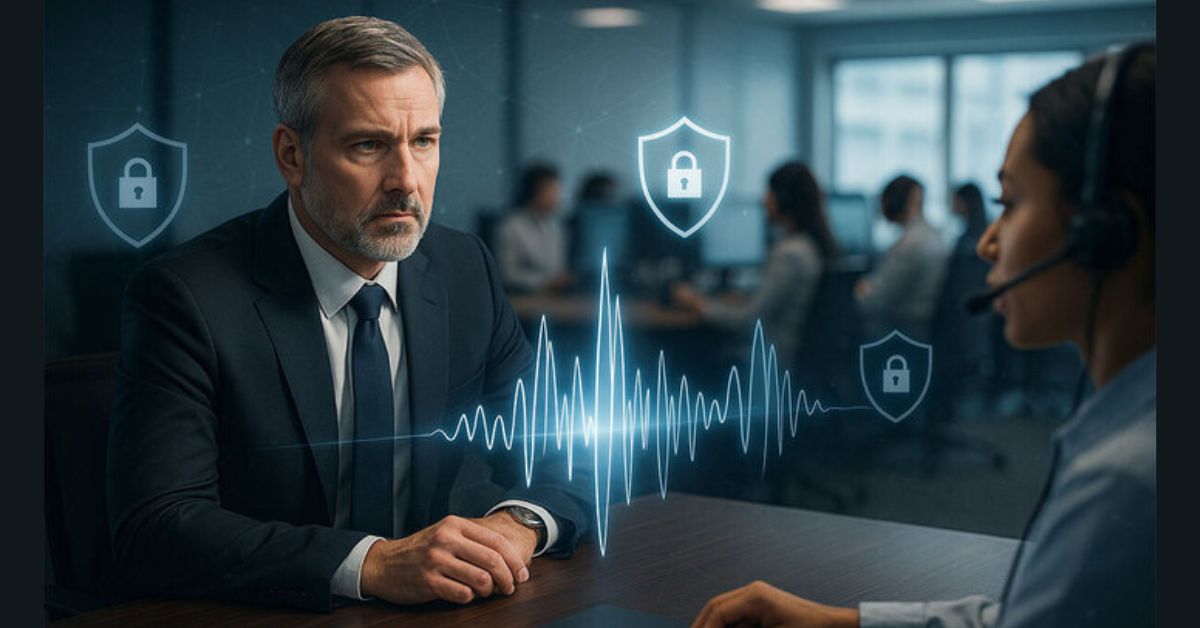
A voice agent is not just another automation tool. It’s a real-time interface between your systems and your customers, and that changes the threat model completely.
Here’s the thing. When something goes wrong with a chatbot, the damage is limited to text. When something goes wrong with a voice agent, the stakes feel higher.
Customers hear a voice. They build trust faster. They share more. That makes security, privacy, and governance impossible to treat as afterthoughts. Before any customer-facing voice system goes live, CISOs need a clear framework for what safe deployment actually looks like in practice.
Why Voice Agents Create a New Security Surface
Voice agents fall into a category of risk all on their own.
Modern voice agents are dynamic. They interpret intent, adapt their tone, and often connect directly to internal systems like CRM, billing, or identity services.
That gives rise to a number of new attack vectors all at once. Weak transport security opens up real-time audio streams to interception. Poor memory and context handling can leak sensitive information. Integration layers become targets because they sit between external users and internal services.
What makes this more complex is speed. Voice agents need to respond in near real-time. That demand for speed can quietly pressure teams to relax controls or delay security hardening in favor of performance.
Latency is a Security Concern, Not Just a Performance Metric
Most teams refer to latency as a user experience problem. In security, latency is also a trust problem.
Most systems fall back to buffering, caching, or retry logic when latency is high. Those workarounds might introduce unexpected persistence of data. They can also create timing gaps that attackers learn to exploit.
Low-latency voice infrastructure reduces these risks. When response time is predictable and tight, there is less need for risky temporary storage and fewer exposed intermediate states. This is one of the reasons some enterprises evaluate platforms such as the Falcon TTS API early in their architecture planning. Consistent response times change how security teams can design safe data flows because fewer compensating mechanisms are needed to keep conversations stable.
The important point is that latency is no longer just a product concern. It is a defensive control.
Data Handling: What Voice Agents Actually Record and Retain?
What is stored, where, and for how long is one of the first questions a CISO should ask.
Voice agents process raw audio, transcripts, metadata, and context logs. Each of these has different privacy and compliance implications.
The audio data itself may be a form of biometric data under some jurisdictions. Audio transcripts may include personal identifiers, account details, or health information. Metadata, such as timestamps, location, and device fingerprints, can be sensitive even when the content looks harmless.
The following will all need to be clearly answered in a secure deployment:
- What is stored by default?
- What can be disabled?
- Where does the data physically reside?
- How long is it retained?
- How is it deleted?
Compliance teams can’t assess risk without these answers, and CISOs are left blind in the case of audits or incident response.
Identity, Authentication, and the Risk of Voice Spoofing
Customer-facing voice agents present new sets of identity challenges. Traditional authentication methods often don’t fit naturally into a spoken conversation.
Many organizations depend on knowledge-based authentication in calls. These methods are weak in an era of leaked data and social engineering. At the same time, voice biometrics introduce their own risks, including spoofing and replay attacks.
CISOs should ensure that the design of voice agents supplements, not replaces, strong multi-factor authentication. The safest of these systems treats voice as a convenience layer, while core identity remains protected through device-based or cryptographic controls.
Fraud detection is equally important. Voice agents need to be hooked up with systems that detect unusual patterns of conversations, unnatural timing of responses, repeated probes, and attempts to escalate.
Scaling Securely: Concurrency and Infrastructure Risks
Voice agents are mostly tested in controlled environments. Real risk appears at scale.
When hundreds or thousands of concurrent calls hit the system, hidden weaknesses surface. Rate limits can fail open. Session isolation can weaken. Logs can be dropped under a heavy load.
CISOs should insist on answers to the following questions before deployment:
- How many concurrent sessions can the system handle securely?
- What happens when the limits are reached?
- How are sessions isolated from each other?
- How is the monitoring maintained under peak load?
A voice agent that operates safely for 50 calls and degrades at 5,000 is not production-ready from a security perspective.
On-premises vs. Cloud: Control, Visibility, and Compliance
Deployment architecture makes a difference.
Cloud-first deployments offer speed, but reduce control. On-premise deployments offer control, but require operational maturity.
For CISOs, this is not just a matter of where the system runs, but also who has visibility. Who can see logs? Who can access raw audio? Who can alter models, prompts, and system behavior?
Legal requirements may force some regulated industries to opt for on-premise or hybrid deployments. Others make sure that data residency is ensured. It has to match not just business goals but also regulatory exposure.
Voice agents aren’t content tools but operational infrastructure. And that changes how the deployment decisions should be made.
Incident Response: When a Voice Agent Fails in Public
Traditional incident response plans rarely take spoken breaches into account.
When a voice agent gives incorrect financial advice, leaks sensitive data, or behaves unpredictably, the damage happens in real time and in public. Customers hear it. Recordings spread. Trust erodes fast.
CISOs should make sure that incident response playbooks include:
- Immediate agent shutdown procedures
- Kill switches at the conversation level
- Real-time monitoring dashboards
- Clear paths of escalation between security, legal, and communications teams
The goal is to halt harm while investigating an issue, not just to fix the problem.
Why Governance and Human Oversight Still Matter
AI voice systems feel autonomous, yet there needs to be human leadership in terms of governance.
Every customer-facing voice agent needs clear ownership. That is, someone needs to be responsible for how it behaves, how often it is reviewed, and how updates get approved.
This includes:
- Prompt control
- Script governance
- Versioning and change management
- Security reviews before deployment changes
CISOs should be deeply involved in setting these guardrails, even if they are not the day-to-day owners.
What Strong Voice Agent Security Actually Looks Like
A secure customer-facing voice agent doesn’t have one single defining feature; it is defined by discipline.
This is what it looks like:
- It sends responses immediately without storing any extra information.
- It authenticates users without using weak signals.
- It scales without breaking isolation.
- It logs without leaking sensitive material.
- It can be stopped instantly when things go wrong.
Above all, it is designed with security as a foundation, not a patch.
Final Thoughts
Customer-facing voice agents have started to become the new normal in digital infrastructure. The technology is powerful, and the business case is real. But for CISOs, the real responsibility is not enabling the feature but protecting the trust that the feature touches.
When voice becomes the interface to customers, security cannot sit behind it. It has to be built into every layer, from latency to logging to governance.
The companies that get this right won’t just deploy voice agents; they will deploy them safely, confidently, and at scale.